Choosing a payment processor is an important decision for any business. The right provider can help you control costs, simplify daily operations and deliver a smoother checkout experience. The wrong one can leave you dealing with confusing fees, unreliable equipment, limited support and a contract that is difficult to exit.
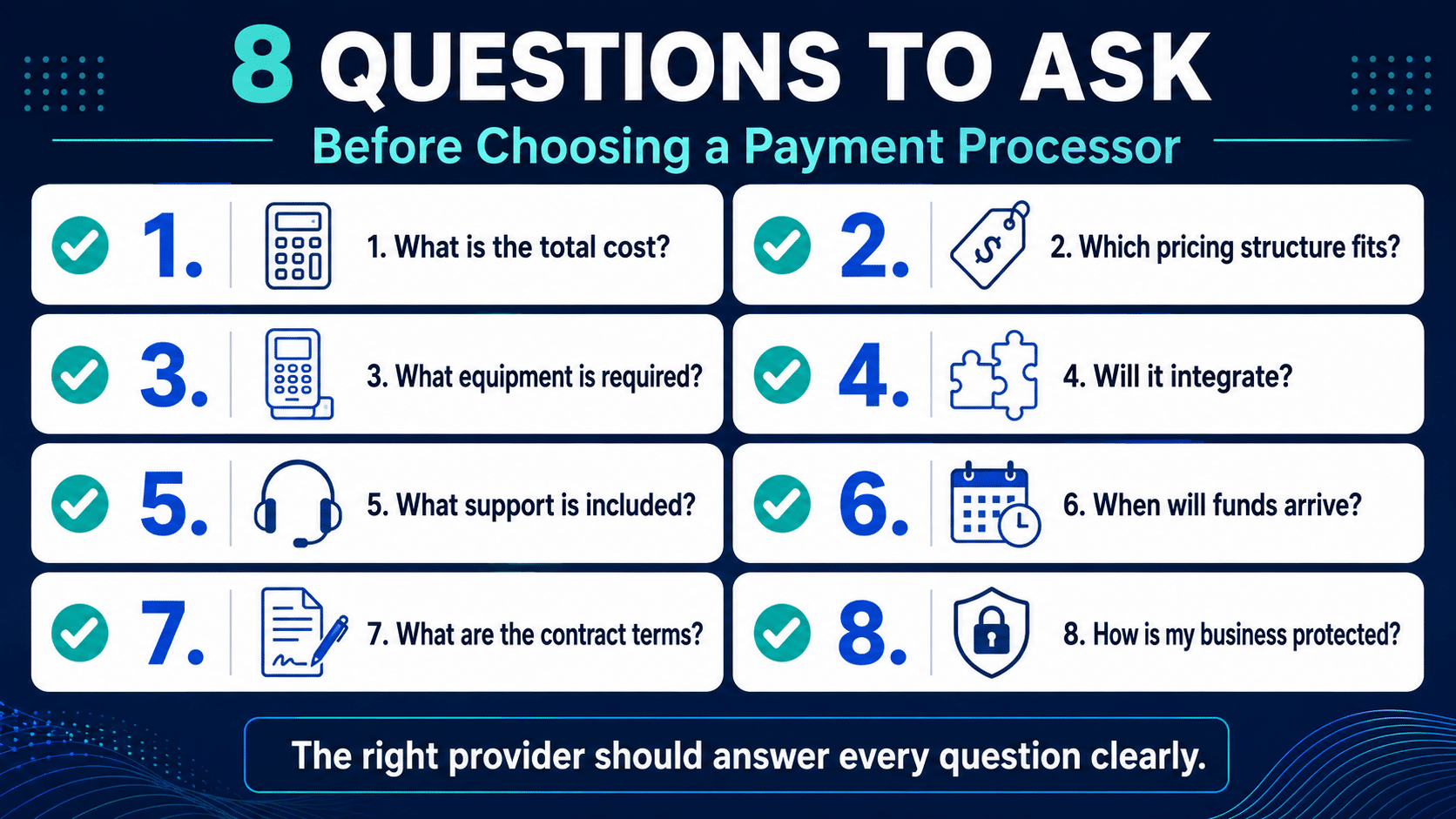
Before signing an agreement, look beyond the advertised rate. Ask these eight questions to understand what you are getting—and what accepting payments will truly cost your business.
1. What Will My Total Processing Cost Be?
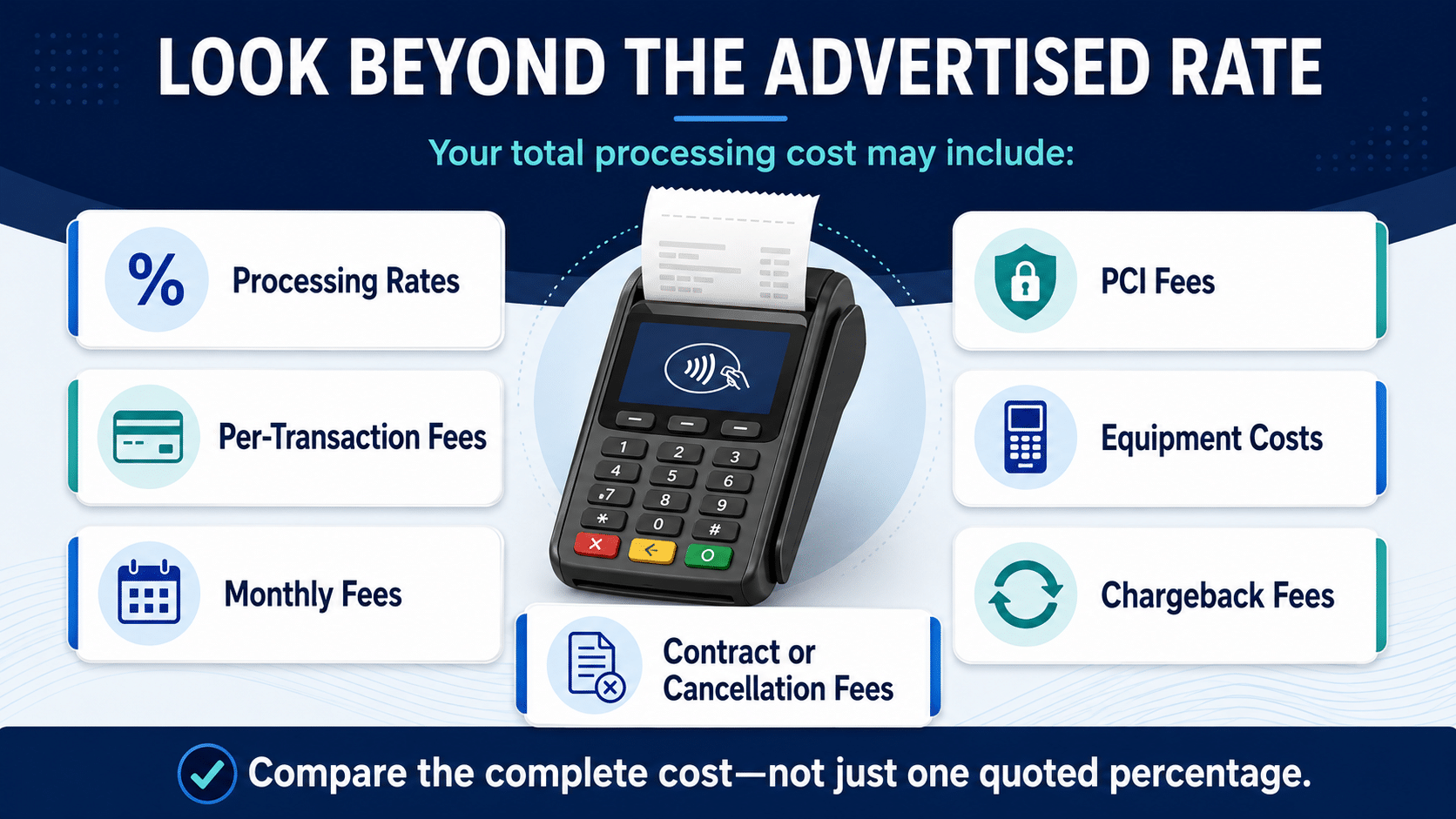
A low advertised rate does not necessarily mean a low overall cost. Your monthly statement may include interchange costs, processor markups, transaction fees, authorization fees, monthly service charges, PCI compliance fees and other expenses.
Ask the provider to explain every charge you should expect, including:
- Percentage-based processing fees
- Per-transaction fees
- Monthly or annual account fees
- PCI compliance or noncompliance fees
- Batch and statement fees
- Equipment and software costs
- Chargeback fees
- Early termination fees
You should also ask whether the pricing is flat-rate, tiered, interchange-plus, dual pricing or another model. The processor should be able to explain the structure in plain language and estimate your total monthly cost based on your actual sales volume and average transaction size.
When comparing proposals, focus on your effective processing rate. This is calculated by dividing your total processing costs by your total card volume. It provides a more complete picture than comparing a few advertised rates.
2. Is the Pricing Structure Right for My Business?
There is no single pricing model that is best for every business. Your ideal setup depends on your transaction volume, average sale, card mix, industry and how customers typically pay.
Traditional processing generally requires the business to absorb card-acceptance costs. Other options, such as dual pricing, allow a merchant to display both a regular card price and a discounted cash price. This can help offset processing costs while giving customers a clear choice at checkout.
Ask the processor which pricing options it supports and why it recommends a particular approach for your business. A trustworthy provider should explain the advantages, limitations and operational requirements of each option rather than pushing every merchant into the same program.
If you are considering dual pricing, cash discount or surcharge, also ask how the provider helps with implementation, signage, receipts, equipment configuration and applicable requirements.
| Model | How it works | Best consideration |
|---|---|---|
| Traditional | Business absorbs processing costs | Familiar customer experience |
| Dual pricing | Card price and discounted cash price are displayed | Helps offset processing costs |
| Cash discount | Discount is applied for cash payment | Implementation and disclosure |
| Surcharge | Fee is applied to eligible credit-card transactions | Card-brand and legal requirements |
3. What Equipment and Software Will I Need?
Your payment technology should fit the way your business operates. A retail store may need an integrated point-of-sale system with inventory management, while a contractor might prefer a mobile card reader or payment links. A restaurant may need handheld devices, kitchen routing and tip management.
Ask whether the proposed solution supports the features you need, such as:
- EMV chip cards
- Contactless and mobile-wallet payments
- PIN debit
- Tips and gratuities
- Digital receipts
- Recurring billing
- Invoicing and payment links
- Virtual terminal payments
- Online ordering
- Inventory and employee management
- Multi-location reporting
- Integrations with existing business software
Make sure you understand whether the equipment is being purchased, leased or provided under another arrangement. Ask who owns it, what happens if it stops working and whether it can be used with another processor.
Leasing payment equipment can sometimes cost substantially more over time than purchasing it. Review the complete equipment agreement separately from the processing agreement before signing.
4. Will the System Integrate With My Existing Technology?
Payment processing does not operate in isolation. Your payment solution may need to communicate with your point-of-sale software, website, accounting platform, customer management system or industry-specific software.
An integration can reduce duplicate data entry, improve reporting and help prevent manual errors. However, not every processor or device will work with every platform.
Ask the provider to confirm compatibility with the systems you currently use. If custom integration work is required, find out:
- Who will complete the integration?
- Is there an additional cost?
- How long will implementation take?
- Who supports the connection after launch?
- What happens if either platform is updated?
Do not rely solely on a verbal assurance that two systems “should work together.” Request confirmation of the specific integration and any limitations before moving forward.
5. What Kind of Customer Support Will I Receive?
Payment problems can quickly become business problems. If your terminal stops working during a busy period or transactions are not funding correctly, you need access to someone who can help.
Ask when support is available and how you can reach it. Determine whether support is offered by phone, email, live chat or through a dedicated representative.
Other helpful questions include:
- Is technical support available after normal business hours?
- Will I have a specific account representative?
- Where is the support team located?
- Is emergency equipment replacement available?
- Who helps with funding, statement or chargeback questions?
- Is support included, or are there additional charges?
A provider should remain accessible after the account is installed. Strong service includes ongoing help with equipment, reporting, pricing questions, employee training and changes as your business grows.
6. How and When Will I Receive My Funds?
Reliable cash flow matters. Ask how long it will take for processed transactions to reach your bank account and whether the provider offers next-day or same-day funding.
Funding times may depend on your business type, processing method, batch-close time, weekends and bank holidays. Transactions processed online or entered manually may also be treated differently from in-person chip-card payments.
Ask the processor to explain:
- Standard funding time
- Daily batch deadlines
- Weekend and holiday funding
- Any cost for faster funding
- Circumstances that could delay a deposit
- How reserves or funding holds are handled
You should also understand how deposits will appear in your bank account and whether processing fees are deducted daily or collected in one monthly amount. Clear reconciliation can make bookkeeping much easier.
7. What Are the Contract Terms?
Before signing, determine how long the agreement lasts and what will happen if you decide to leave.
Some processing agreements renew automatically or include an early termination fee. Equipment leases and software subscriptions may have separate terms that continue even after the processing account is closed.
Ask for clear answers to the following questions:
- Is there a contract term?
- Does the agreement renew automatically?
- How much is the early termination fee?
- How much notice is required to cancel?
- Are equipment and software covered by separate agreements?
- Can rates or fees change during the contract?
- What happens to stored customer or transaction data if I leave?
Read the written agreement rather than relying on a salesperson’s summary. If a promised rate, feature or waiver is important to your decision, make sure it appears in writing.
8. How Will You Help Protect My Business?
Every business that accepts card payments has security responsibilities. Your processor should provide technology and guidance that help protect payment information and reduce fraud risk.
Ask how the provider supports PCI DSS compliance and whether it charges separate compliance fees. You should also determine what security features are included, such as tokenization, encryption, EMV acceptance, address verification and transaction alerts.
Fraud risks can differ by transaction type. In-person chip transactions, online payments and card numbers entered over the phone may each require different precautions.
Ask what tools are available to help prevent chargebacks and how the provider assists when a dispute occurs. You should understand how chargeback notifications are delivered, how long you have to respond and what documentation may be required.
Security cannot eliminate every risk, but the right combination of technology, procedures and support can significantly reduce your exposure.
Look Beyond the Rate
Choosing a payment processor should not come down to one quoted percentage. Pricing matters, but so do equipment, integrations, funding, support, security and contract terms.
A good processor will take time to understand how your business operates, explain your options clearly and provide a complete picture of what you will pay. If a provider avoids your questions, pressures you to sign quickly or cannot explain its own proposal, consider that a warning sign.
AerPay helps businesses evaluate their current payment setup and find a solution aligned with their operations, customers and financial goals. From traditional processing and dual pricing to modern POS systems and integrated payment technology, our team can help you understand your options before you make a decision.
Ready to take a closer look at your payment processing? Contact AerPay for a complimentary statement analysis and personalized consultation.